You booked the rental truck, lined up the boxes, and maybe hired a crew to do the lifting. Then you look at the street outside your Squirrel Hill or Lawrenceville apartment and see a solid line of parked cars. Where does a 20-foot truck go on moving day?
Inside the City of Pittsburgh, the answer is usually a moving permit. This guide covers who needs one, what it costs, how long it takes, and what to do about parking meters and suburbs, using the City's own rules.
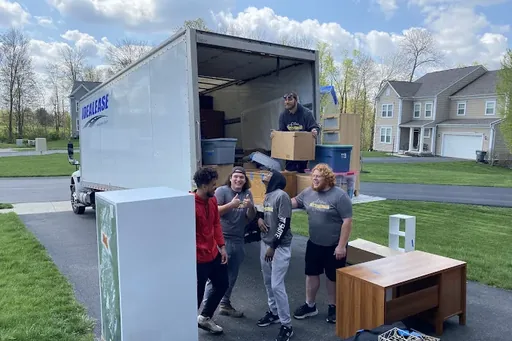
It matters most when you run the truck yourself. With our labor only movers, you bring the rental truck, PODS, or U-Box and we do the heavy lifting, so the parking spot is part of your plan.
Do I need a permit to park a moving truck on a Pittsburgh street?
Yes, if you want to hold street parking for the truck. The City's Department of Mobility and Infrastructure (DOMI) says a person or company must apply for a Moving Permit to block one or more on-street parking spaces for moving. The same permit can reserve part of the parking lane for a moving container, like a PODS unit (DOMI Moving Permit Information Sheet).
Without a permit, you are counting on finding open curb space at the right moment. On narrow East End streets, that is a gamble. Even with a permit, the truck or container still can't break posted parking or street-cleaning rules.
What does a Pittsburgh moving permit cost?
DOMI lists two fees on its current information sheet:
- Moving truck: $50 per truck, good for up to two days.
- Moving container: $80, good for up to two weeks.
These are City fees, paid to the City. They are separate from what you pay for the truck rental or for movers. Check the information sheet before you apply, since the City sets and updates the amounts.
Do I need two permits if I'm moving within the city?
Yes. If you are moving from one address in the City of Pittsburgh to another, DOMI requires a moving permit for each address. That is two permits in total. A move from Shadyside to Squirrel Hill, for example, needs one permit for the pickup and one for the drop-off.
If only one end of the move is in the city, you need the City permit for that end. The other town may have its own rules (more on that below).
How far ahead should I apply?
Give yourself at least two weeks, and more if you can. Here is how DOMI describes the timing:
- You pick a preferred start date. A truck permit runs two days from that date, and a container permit runs fourteen days.
- If your application is missing something, DOMI will tell you within three business days.
- Once it is complete, allow one week for DOMI to review it and approve or deny it.
- If the permit comes with a "No Parking" sign, the sign has to be up at least 48 hours before the permit starts.
Add those together and a last-minute application can easily miss your moving day. The permit can't be extended or amended either. If the move isn't finished in the permit window, you have to apply for a new one.
Applications go through the City's OneStopPGH portal. DOMI's applicant guidance page links the moving permit sheet and lists its permit line and counter hours if you get stuck.
What information do I need to apply?
DOMI asks for:
- Your name and contact information
- The moving address (or the block and cross streets if there is no address)
- The start date
- The number of trucks or containers, if asked
- The moving company name (optional)
What are the rules for "No Parking" signs?
If your permit includes temporary "No Parking" signs, the City's sign posting policy spells out how to put them up:
- Post them 48 hours before the permit starts, where drivers can clearly see them.
- Put them only in the area your permit covers, no more than 50 feet apart.
- Attach them to sign posts, metal or wooden poles, or cones. Not trees, cars, buildings, private property, or the ground.
- Handwritten or homemade signs are not honored.
- Take time-stamped photos once the signs are up.
Those photos matter. If someone parks in your spot after the signs have been up for more than 48 hours, the policy says you can contact the local police for permission to tow, and the police will ask for time-stamped photos showing the signs were posted in time.
Take the signs down when the move is done.
What if the only spot is at a parking meter?
Metered spaces need one more step. DOMI's applicant guidance says that for permits in metered parking zones, you also contact the Pittsburgh Parking Authority. The Parking Authority's meter policies page explains that it takes meters out of service on request. It will ask for the address, the number of spaces, the meter numbers, and the dates, and it charges per meter.
Write down the meter numbers in front of the building before you call. It saves a round of back-and-forth.
Do the suburbs require a moving permit too?
The City permit covers addresses inside the City of Pittsburgh, including neighborhoods like Squirrel Hill, Shadyside, Lawrenceville, and the Strip District. Boroughs and townships set their own rules.
Mt. Lebanon, for example, has its own request form for reserving parking meters on move-in and move-out days, handled by its parking office. If you are moving to or from a suburb, call that municipality's office a few weeks ahead and ask what they need.
How do I plan a city move with a rental truck?
A short checklist that works for most apartment and rowhouse moves:
- Pick your date and truck size first. The permit is tied to a start date.
- Apply for the permit early. One for each city address.
- Handle meters separately with the Parking Authority if your spot is metered.
- Post signs 48 hours ahead and take time-stamped photos.
- Book your help. Our labor only crews are busiest from May through September, so book 2 to 4 weeks ahead in those months.
- Tell the crew about the street and the stairs. Let us know where the truck will be, how far it is from the door, and how many flights there are at each end.
For more on walk-ups, elevators and building rules, read our guide to mastering apartment moves. If you are still deciding whether to drive the truck yourself, see when to hire labor only movers.
Ready to line up the lifting?
Once the truck and the permit are sorted, the heavy part is what's left. Our crews do third-floor walk-ups nearly every day, and they pad and secure every load so nothing shifts on the road. Moving in the East End? See our Squirrel Hill moving page.
Share your date, both addresses, and what is moving on our quote page, and we will help you plan the day.